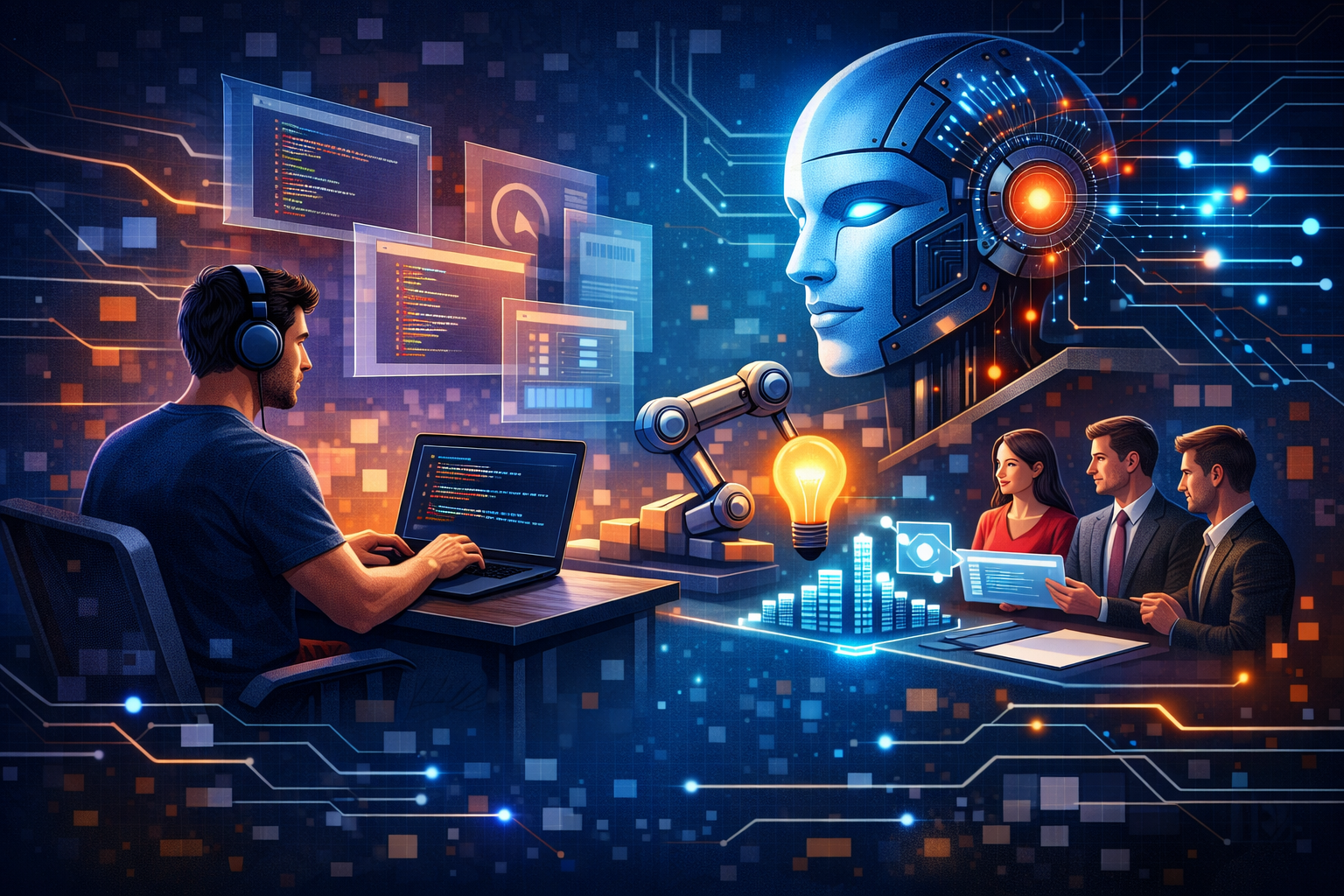
The Developer Role Is Evolving with AI
Every technological leap in software development comes with the same worry: Will this replace developers? We heard it with the .NET Framework. We're hearing it again with AI. But history suggests we should be less concerned about replacement and more focused on adaptation.
The reality is simpler and more optimistic than the headlines suggest. AI isn't eliminating software developers—it's fundamentally changing what the job looks like.
The Pattern Repeats: Abstraction Drives Evolution
When the .NET Framework emerged, experienced developers protested that it abstracted away too much, making their expertise obsolete. They weren't wrong about the abstraction—but they missed the larger point.
Abstraction didn't eliminate developers; it freed them. Instead of wrestling with low-level infrastructure details, developers could think differently about problems rather than implementation mechanics. Teams shipped faster. They built bigger things. New possibilities opened up.
AI is following the same trajectory. Tools like GitHub Copilot, Claude, and ChatGPT aren't replacing developers—they're abstracting away routine coding tasks. Just as the .NET Framework did decades ago, AI allows teams to move at a different speed and operate at a higher level of abstraction.
From Coder to Product Engineer
The most significant shift AI enables isn't technical—it's organizational. Companies embracing AI aren't asking developers to code less. They're asking developers to think differently.
At organizations heavily invested in AI adoption, developers are transitioning from pure software engineers to product engineers. This means:
- Moving left in the development cycle: Instead of waiting for fully defined specifications, developers are involved earlier, working directly with product strategy and customer problems. - Shorter feedback loops: Features can move from concept to prototype to customer feedback to production in days instead of weeks. - Direct customer engagement: Developers spend less time in isolated sprints and more time understanding what customers actually need.
This acceleration is remarkable. What might have taken three weeks of planning, development, and review now happens in three days. Multiple prototypes that would have consumed weeks of work can be built, tested, and presented to stakeholders in a single week.
The Ripple Effect: Everyone Moves Left
But here's what's often overlooked: when developers move left in the development cycle, everyone moves left. Product managers and product owners face their own disruption.
Traditional product management focuses on: - Detailed sprint planning - Individual story prioritization - Precise cycle-time estimates
In an AI-accelerated environment, these practices become bottlenecks. Product owners need to shift from managing execution details to identifying customer problems worth solving. Instead of planning sprints around story estimates, they're handing developers high-level customer challenges and expecting solutions in days.
This is uncomfortable. It moves product leaders further from the day-to-day execution they may have thrived on. But it's the same discomfort developers are experiencing—and it's the same reason it's ultimately valuable.
The Real Advantage: Speed and Iteration
When tools and processes align, the competitive advantage becomes clear. Teams can:
- Prototype rapidly: Build multiple solutions to test with customers quickly - Iterate based on real feedback: Changes move from customer input to deployment in hours or days - Reduce waste: Failed approaches are discovered and abandoned before weeks of effort are invested - Ship more: Volume and velocity of shipping increase significantly
This isn't a theoretical benefit—it's being realized by teams already adapting to AI-assisted development.
Adaptation Is the Real Skill
The question facing software developers isn't whether AI will replace them. History strongly suggests it won't. The real question is: Will you adapt to the new role?
Developers who learned .NET didn't disappear. They evolved. They stopped writing boilerplate and started solving problems at a higher level. They became more valuable, not less.
The same opportunity exists with AI. The developers thriving in this shift are those who:
- Embrace AI tools as collaborators, not threats - Learn to think in terms of customer problems, not just code - Develop stronger product and design intuition - Build relationships with customers and product stakeholders - Iterate quickly and learn from feedback
Change, Not Replacement
Software development is changing. The tools are different. The pace is faster. The role encompasses more business context and customer understanding. But developers are still central to the process—arguably more central than ever to driving innovation.
We've been here before. We adapted then. We'll adapt now. The future of software development isn't scary—it's just different. And different is an opportunity.