AI Won't Replace Developers—Intentionality Will
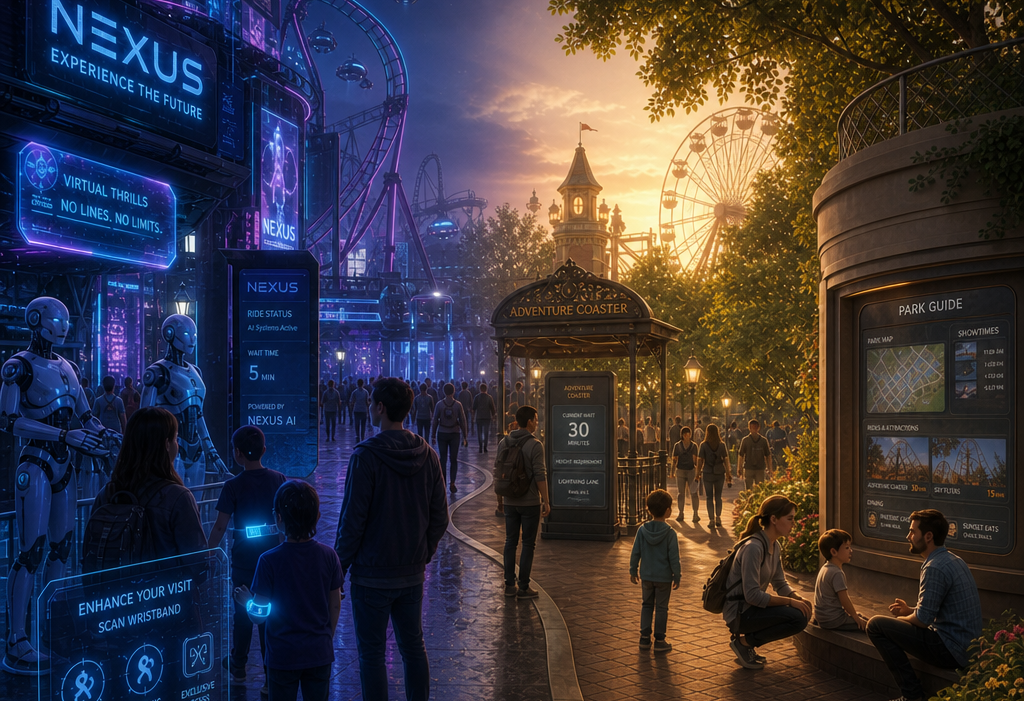
I recently spent a week visiting major theme parks in Florida, and something struck me: the way parks use technology mirrors the current AI revolution in software development. Both reveal a critical truth: tools are only as good as the intention behind them.
When Technology Becomes a Crutch
Modern theme parks have access to incredible technology—3D projection without glasses, immersive screen-based experiences, synchronized effects that create believable worlds. When used thoughtfully, this technology genuinely elevates the experience. A well-designed ride that blends physical sets, practical effects, and digital elements creates something magical.
But I also rode attractions that felt fundamentally lazy. You'd be strapped into a seat, whisked into a small dark room, forced to watch a video clip on a giant screen, then shuffled to the next room for another video. Repeat. The rides felt like sophisticated mall kiosks—technology for technology's sake, with no consideration for what actually makes an experience memorable or engaging.
The difference came down to a single question: Did the creators build this attraction with the guest's experience in mind, or did they build it because they could?
The AI Development Parallel
The same dynamic is already emerging in software development. Yes, AI tools can generate code faster than humans ever could. Some companies will absolutely leverage this to ship products at unprecedented speeds. But speed without purpose creates the digital equivalent of those screen-filled theme park rides: a technically complete product that feels hollow.
Consider what separates a well-designed application from a generic one:
- Thoughtful user flows that match how people actually work, not how engineers think they should - Intentional feature prioritization that solves real problems instead of adding everything possible - Attention to detail in error handling, accessibility, and edge cases that users encounter - Product coherence where each component reinforces the others instead of feeling bolted on
AI can generate code that technically accomplishes all of these things. But it does so without understanding why those details matter. An AI system doesn't inherently know whether a feature serves the user or just inflates the feature list. It doesn't feel the friction of a confusing workflow. It can't ask the fundamental question: "Does this serve the customer, or are we building this because we can?"
What Developers Will Actually Do
The developers who remain valuable—and indispensable—will shift their focus. The commodity is no longer writing code. Eventually, AI will write code faster, more consistently, and with fewer mistakes than any human ever could.
Instead, developers will need to become:
Strategic thinkers who understand business problems deeply enough to ask the right questions before a single line of code is written. What are we really solving? Who uses this and how? What would success actually look like?
Experience designers who can envision how customers will interact with software and catch disconnects between technical capability and actual usability. They'll be the ones saying, "We can build this, but should we?" or "Our users will hate this workflow."
Judgment makers who understand tradeoffs and can advocate for intentional restraint. Adding every feature AI can generate is like filling a theme park with every attraction technology allows—it dilutes the experience and confuses the customer.
Quality gatekeepers who understand that a product shipped quickly without strategic thinking is almost worse than no product at all. The rides that felt cheap weren't broken—they were just soulless.
The Market Reward for Intention
History suggests this plays out clearly. Companies that use new tools as pure productivity boosts—"Let's ship twice as fast"—often end up with twice as much technical debt and customer frustration. Companies that use new tools to focus more effort on the why and how end up with products people genuinely want to use.
The theme parks that succeed long-term aren't the ones with the most screens. They're the ones that use technology as an enabler of storytelling and immersion, not as a substitute for thoughtful design. Those parks understand that a perfect 3D projection in a thematically incoherent space is just a distraction. But a carefully chosen moment of digital magic that surprises you and enhances a narrative? That's memorable.
Software will follow the same pattern. The startups and companies that gain real traction won't be the ones that used AI to blast out the most features fastest. They'll be the ones that used AI to free their developers from writing boilerplate so those developers could focus entirely on understanding customer needs and building products that genuinely delight.
The Evolving Developer Role
This shift requires developers to develop new skills:
- Curiosity about the problem domain, not just the technical implementation - Communication ability to translate between customer needs and technical solutions - Taste and judgment about what makes software feel polished versus cheap - Ownership mentality that extends beyond "code that compiles" to "experience that resonates"
Yes, you'll need to understand AI tools and how to work with them effectively. But the developers who become truly irreplaceable will be those who can use AI as a force multiplier for their judgment, creativity, and strategic thinking—not those who can just prompt an AI more cleverly than the next person.
Conclusion
My trip to the parks taught me that the most powerful technology is invisible. It serves a purpose larger than itself. The worst technology draws attention to itself because there's nothing beneath it.
As AI reshapes development, the question isn't whether developers will still be needed. They absolutely will be. The question is whether developers will evolve from being "people who write code" to being "people who ensure software serves real human needs in elegant, intentional ways."
The rides that used screens brilliantly didn't do it because they had access to the best screen technology. They did it because someone asked a hard question: What experience do we want our guests to have? Then they used every tool available—screens, practical effects, narrative design, pacing—to serve that vision.
That's the future of development. Not faster code generation. Faster thinking about what code should actually do.